Cleared for Exercise After Baby — But Not Sure Where to Start?
Cleared for Exercise After Baby — But Not Sure Where to Start?
Here’s What to Do First
You finally got the green light from your OB or midwife. You’re cleared for exercise. And now you’re standing there wondering: where do I even begin?
First, take a breath. Getting that clearance is a milestone — but it’s the starting line, not a sprint to your pre-baby fitness routine. If you’ve ever played a sport, you know you don’t show up on the first day of the season and go full speed. You build back in. Postpartum should be no different.
Why “Cleared for Exercise” Doesn’t Mean “Go Back to Normal”
The six-week postpartum checkup is standard, but here’s the reality: six weeks is often not enough time for your body to fully heal — especially if you delivered vaginally, experienced tearing, or had a C-section. Your pelvic floor, deep core, and connective tissues have been through an enormous amount of change over nine-plus months, and they need a gradual, intelligent return to load.
Jumping back into high-impact workouts, heavy lifting, or intense fitness classes too soon is one of the most common reasons new moms develop or worsen symptoms like:
Leaking with exercise (stress urinary incontinence)
Pelvic heaviness or pressure
Low back and hip pain
Diastasis recti (separation of the abdominal muscles)
Getting cleared is permission to begin the process. It’s not permission to skip it.
Start with the Basics — and Actually Master Them
Think of postpartum recovery like preseason training. Athletes who have been off for months don’t open with max-effort days. They start with fundamentals: movement quality, breathing mechanics, and building a foundation before adding intensity.
For new moms, that foundation starts with the pelvic floor and deep core.
Breathing: Diaphragmatic breathing — where your belly and rib cage expand on the inhale and gently fall on the exhale — is the starting point for reconnecting with your core. Your breath and your pelvic floor work together. Learning to coordinate them properly is step one.
Pelvic floor activation and relaxation: It’s not just about doing Kegels. Many postpartum women have pelvic floors that are actually too tight, not too weak, and squeezing more only makes things worse. Learning to both contract and fully release the pelvic floor is essential.
Deep core engagement: Before you do a single crunch or plank, you need to reconnect with your transverse abdominis — the deepest layer of your abdominal muscles. These stabilize your spine and support everything above your pelvis.
Hip hinging and glute activation: Your glutes likely took a back seat during pregnancy. Basic movements like glute bridges and bodyweight hip hinges help reestablish the posterior chain without overloading the pelvic floor.
Once these foundations feel solid — and that can take weeks, not days — you can begin layering in more movement.
Don’t Forget Rotation and Side-to-Side Movements
Here’s one piece that often gets overlooked in postpartum exercise programs: rotation and lateral movement.
Most early postpartum guidance focuses on forward-and-back patterns — bridges, squats, walking. But rotational and side-to-side movements are critical for building full-body strength and restoring the way you actually move in real life. Think about reaching across your body to pick up your baby, twisting to buckle a car seat, or carrying a diaper bag on one side. These are rotational and lateral demands, and if you never train them, your body doesn’t rebuild the strength to handle them well.
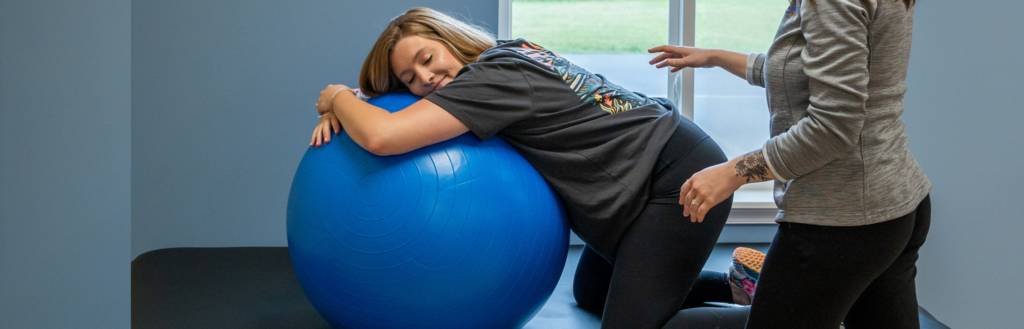
Lateral band walks, side-lying hip work, and gentle rotational exercises — done with proper breathing and core engagement — should be a part of your progressive return to movement. A physical therapist can help you sequence these movements appropriately so you’re building strength without compensation.
The Mental Load Is Real — Give Yourself Grace
Postpartum recovery doesn’t happen in a vacuum. You’re managing sleep deprivation, feeding schedules, emotional adjustment, and an entirely new version of daily life. Feeling overwhelmed about exercise is completely valid.
The goal right now isn’t to get your body “back.” Your body did something extraordinary. The goal is to rebuild strength and function from the inside out, at a pace that makes sense for where you actually are — not where you think you should be.
Progress in this phase is less about how much you’re doing and more about how well your body is responding to what you’re doing. Are your symptoms improving? Are you able to do daily tasks without pain or leaking? That’s progress.
How Postpartum Physical Therapy Fits In
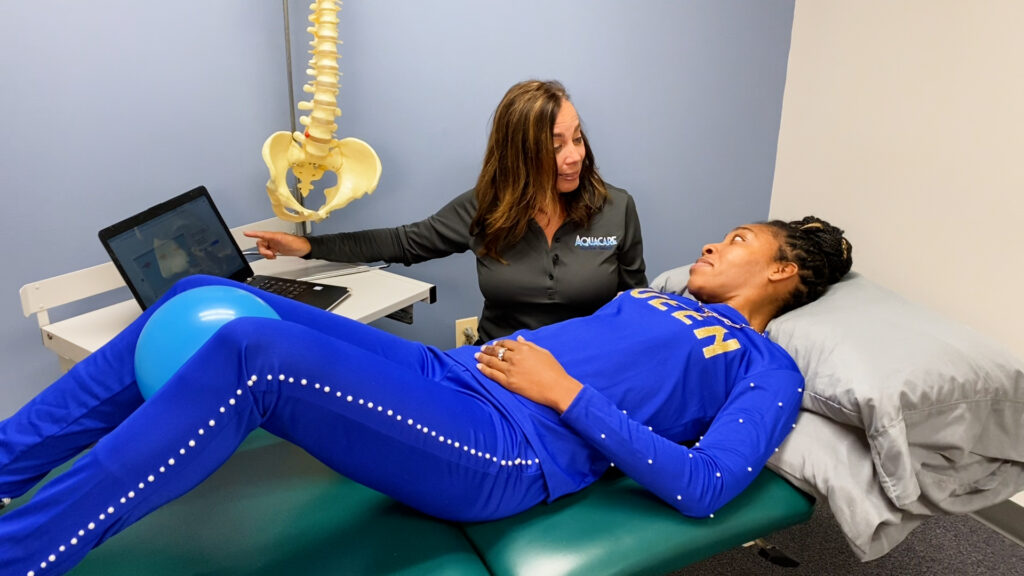
Even if you feel “fine,” a postpartum evaluation with a pelvic floor physical therapist is one of the best investments you can make in your long-term health.
At Aquacare Physical Therapy, our pelvic health specialists work one-on-one with postpartum women to assess pelvic floor strength and coordination, identify any diastasis recti or core weakness, evaluate posture and movement patterns, and build a personalized return-to-exercise plan that keeps up with your goals — whether that’s getting back to running, returning to the gym, or simply getting through your day without leaking or pain.
We offer pelvic floor physical therapy at multiple locations across Delaware and Maryland, including two locations in Lewes, as well as Millville, Milford, Salisbury, Berlin, Easton, Annapolis, and Kent Island. Pelvic floor therapy for postpartum recovery addresses far more than Kegels — it encompasses breathing mechanics, scar tissue (for C-section deliveries), core rehabilitation, and the full-body demands of new motherhood.
You Don’t Have to Figure This Out Alone
Returning to exercise after having a baby should feel empowering, not intimidating. With the right guidance, a smart progression, and support from professionals who specialize in women’s health, you can rebuild strength and confidence on a timeline that actually works for your body.
Ready to get started? Schedule a free consultation with one of our pelvic floor specialists at Aquacare Physical Therapy. We’re here for every step of your postpartum recovery — from the basics all the way back to the goals that matter most to you.
 Aquacare/Fitness Forum Physical Therapy