
What Can You Expect With Back and Spine Treatment?

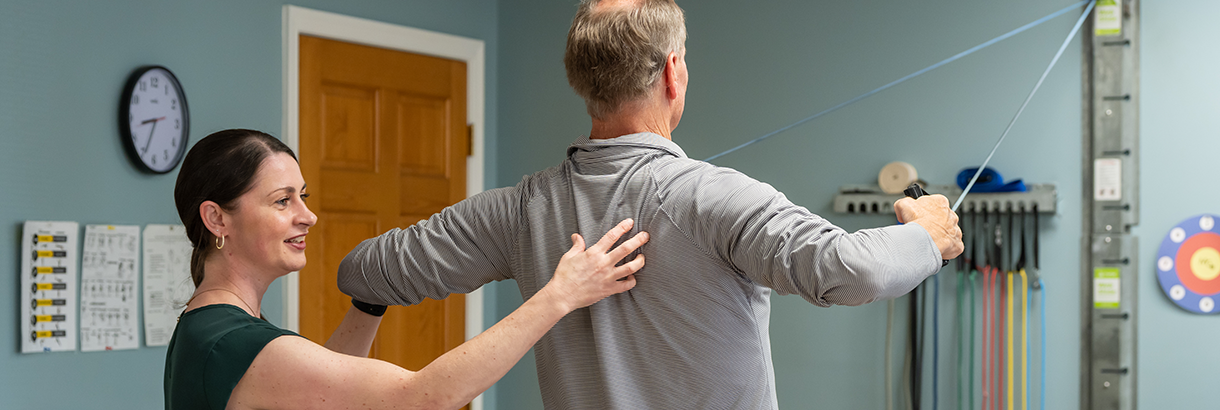
Every patient is different, but most of our back and spine patients follow a plan similar to the one below. Each visit includes hands-on treatment tailored to you, and each one builds on the last so you leave with real skills you can use at home, at work, and at play. Along the way, you’ll receive a home exercise program that grows with you.

Visit 1: Getting to Know Your Back

Your first visit starts with a thorough evaluation so we can understand your pain, your history, and what you want to get back to doing. Then we’ll show you what’s going on inside your spine using diagrams and a spine model, because back pain feels a lot less scary when you understand it. You’ll learn how to find your neutral spine, the position where your back is best supported, and how to use abdominal bracing to protect it. You’ll head home with a simple stretching program to start feeling better right away.

Visit 2: Building a Strong Foundation

We’ll review your neutral spine and abdominal bracing to make sure they feel natural, then talk about posture and how small changes can take pressure off your back. From there, we’ll start teaching healthy movement patterns, like hinging at the hips instead of rounding your back, pivoting instead of twisting, and shifting your weight smoothly. These become the building blocks for everything that follows.

Visit 3: Putting Movement to Work

This is where the skills start showing up in real life. We’ll practice the everyday transitions that often trigger back pain: standing up from a chair, getting down to and up from the floor, lying down and sitting up in bed, and getting in and out of the car. You’ll also practice pivoting from standing, sitting, half kneeling, and a wide sumo stance, along with pushing, pulling, and reaching at different heights so your back stays protected no matter what the task.

Visit 4: Sitting, Sleeping, and Standing Smarter

Many of us spend hours in the same position without realizing how much it affects our backs. In this visit, we’ll look at how you sit, stand, and sleep, and we’ll help you set up your computer or workstation so your spine gets the support it needs throughout the day.

Visit 5: Lifting and Carrying Without Fear

Lifting is one of the most common causes of back injuries, so we’ll give it the attention it deserves. You’ll learn several safe lifting techniques, including the squat lift, the squat with a pivot, the half kneel lift, and the golfer’s lift (a one-leg reach that’s great for picking up light objects), with and without a hand on a counter or table for support. We’ll practice carrying, then put it all together by lifting objects from the floor to waist, shoulder, and overhead height.

Visit 6: Back to Your Real Life

Now we bring it home, literally. We’ll practice the chores and activities that fill your days, such as vacuuming, mopping, and sweeping, loading and unloading the washer, dryer, and dishwasher, carrying a laundry basket, making the bed, dusting, brushing your teeth, and working in the yard. If there’s a hobby or sport you’re eager to return to, this is the time to work on it together.

Visit 7: Filling in the Gaps

This visit is all about you. We’ll revisit anything that still feels tricky, answer lingering questions, and fine-tune your home exercise program so you feel confident on your own.

Visit 8: Checking Your Progress

At your re-evaluation, we’ll measure how far you’ve come and compare it to where you started. Together, we’ll decide whether you’re ready to continue independently or whether a few more visits would help you reach your goals.

Physical Therapy for Back and Spine

Is Back Pain Making You Miss Out on Living?

Maybe it’s the golf game you’ve been skipping, the grandkids you can’t scoop up, or the simple fact that getting out of the car has become a project. Back pain has a way of shrinking your world a little at a time. The good news is that it doesn’t have to stay that way.

At Aquacare and Fitness Forum Physical Therapy, our back and spine program is built to do more than calm your pain for a few days. We help you understand what’s happening in your spine, teach your body safer ways to move, and give you the tools to keep doing the things you love long after your last visit.

Can Physical Therapy Really Help Back Pain?

Yes. For most people with back pain, physical therapy is one of the most effective first steps, and major medical guidelines recommend movement-based care before medications, injections, or surgery for many types of low back pain. Physical therapy works on the root of the problem: how your spine is supported, how you move, and how you hold your body throughout the day. When those things improve, pain often follows.

What Back and Spine Conditions Does Physical Therapy Treat?

Our therapists help patients with a wide range of back and neck concerns, including herniated or bulging discs, sciatica, spinal stenosis, degenerative disc disease, arthritis of the spine, muscle strains and spasms, posture-related pain, and recovery after spine surgery. Whether your pain started with one wrong move or has been building for years, we’ll build a plan around your body and your goals.

Can Physical Therapy Help Me Avoid Back Surgery?

For many people, it can. A large share of back pain improves with conservative care like targeted exercise, education, and movement retraining. If surgery does turn out to be the right path for you, working with a physical therapist beforehand can help you go into the procedure stronger and recover more smoothly afterward.

What Makes Back Care at Aquacare Different?

When you come to Aquacare, your physical therapist works with you one-on-one for your entire session. We don’t double book, so you’re never left alone on a machine while your therapist juggles other patients. That focused time is what lets us fine-tune your movement, answer your questions, and adjust your plan as you improve.

With more than 12 locations across Delaware and Maryland, expert care is close to home. Select locations also offer aquatic therapy, where the support of warm water can make movement easier and more comfortable for sore backs.

FAQs
In most cases, no. Both Delaware and Maryland allow patients to see a physical therapist directly, though some insurance plans have their own referral requirements. Our team is happy to check your coverage before your first visit.

Many patients follow a plan of about eight visits, similar to the one above. Some people feel better sooner, while others with longer-standing or more complex pain benefit from additional care. Your therapist will set a timeline based on your evaluation and your goals.

Physical therapy should challenge you, but it shouldn’t make your pain worse. Your therapist will work within your comfort level and adjust your treatment as you progress. Most patients find that learning how to move safely actually reduces their pain and worry.

If your back pain lasts more than a few days, keeps coming back, or gets in the way of work, sleep, or activities you enjoy, it’s a good time to see a physical therapist. Starting early can help keep a short-term problem from becoming a long-term one.

Seek immediate medical care if your back pain comes with loss of bladder or bowel control, numbness in the groin or inner thighs, sudden weakness in your legs, fever, or if it follows a serious fall or accident.

Wear comfortable clothing you can move in easily, such as athletic pants or shorts, a T-shirt, and supportive sneakers.

Most insurance plans, including Medicare, cover physical therapy. Coverage details vary by plan, so our front desk team will help you understand your benefits before you begin.

Ready to Get Back to Living?

You don’t have to plan your days around your back. Our physical therapists are ready to help you move with confidence again.